
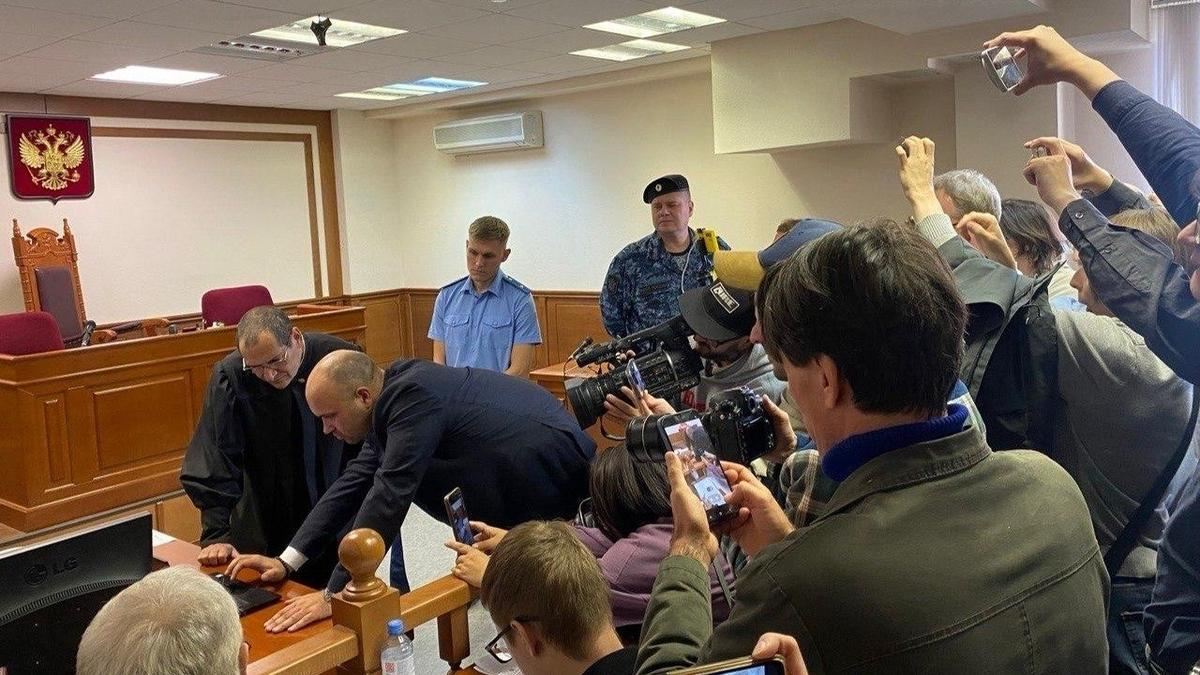
“Clearing” the regional lists of “Yabloko” in the upcoming elections continues: after the lawsuit in the Pskov region, similar lawsuits have been filed in courts in Kaliningrad and Sverdlovsk.
“Such” is not just a figure of speech: both lawsuits, although filed by different parties in different cities, coincide textually by two-thirds. Both were considered on the same day, August 28. Both were satisfied (with the local channels reporting that the rating of “Yabloko” in Sverdlovsk has already reached 10%) following the described scheme of a “contractual match” in the “Novaya Gazeta”: a lawsuit is filed by a pro-government party, which is immediately taken up by the court, supported by the same election commission that registered the list, and backed by the prosecutor’s office. This means that a command has been given — and from the federal level — to eliminate the line in the ballot for the regional elections: “World, freedom, life without fear”. However, while the line in the ballot can be removed, the desire of tens of millions of people to live according to this principle cannot be taken away.
In the Kaliningrad region, the lawsuit was filed in court by the “Communists of Russia”, and in the Sverdlovsk region, it was filed by the LDPR. The lawsuit of the “Communists of Russia” is based on the same allegations that were used in the lawsuit by “Rodina” when they removed the federal list of the party. The “Communists” accused “Yabloko” (and its Kaliningrad branch) of using social networks for campaigning, access to which is prohibited or “slowed down” in Russia (Telegram is even mentioned), and that allegedly violated intellectual property laws during the campaign (including references to interviews with Grigory Yavlinsky). The LDPR lawsuit adds another argument (also borrowed from the “Rodina” lawsuit) — that “Yabloko” allegedly used means from the electoral fund “beyond the maximum limit set by law”. Analyzing all this from a legal point of view is futile — all these claims were dismantled point by point in the Supreme Court. There, “Yabloko” lawyers proved that the campaigning on social networks by third parties, unrelated to “Yabloko”, cannot be “imputed” to the party as if it were paid for outside the electoral fund. It cannot equate third-party posts and videos about “Yabloko” to commercially commissioned party advertisements. Also, no intellectual property rights were violated. However, all this had no slightest impact on the court as the decision was not made based on legal but political objectives.
Just like in the Supreme Court, these and other arguments were ignored by the court in Yekaterinburg, where representatives of “Yabloko” Yaroslav Shcherbakov, Konstantin Kiselev, and Leonid Buiyny spoke about the need to separately consider the federal “Yabloko” campaign and the election campaign in the Sverdlovsk region. The plaintiff — LDPR — refers to articles of law that do not justify removing the list, the actions of citizens supporting “Yabloko” are not the party’s responsibility, and Grigory Yavlinsky’s interview is not campaign material and does not mention the elections in the Sverdlovsk region. The circumstances of the federal campaign cannot automatically serve as a basis for deregistering the regional list. All in vain. However, the LDPR argument in court that by urging donations for the campaign and explaining how to do so, the party “could mislead voters by suggesting that Sber and Ozon-Bank also support Yabloko” was heard, — Kiselev, the leader of the Yabloko list, and the head of the party’s faction in the Yekaterinburg city council said. In the Kaliningrad region, everything repeated itself, with a representative of the “Communists of Russia” Maxim Makarov going so far as to argue in court that Yabloko’s demand for peace (included in its program) is allegedly “extremism”. The plaintiff’s representatives constantly referred to the decision of the Supreme Court — although there is no precedent law in Russia, and the “Communists of Russia” did not participate in the process in the Supreme Court, and its practice cannot be applied on the basis of precedent. Roman Morozov, Yabloko’s lawyer, argued in court that the plaintiff supposedly reported violations of campaigning rules on blocked or prohibited social networks, but the plaintiff himself couldn’t review or identify the messages without using forbidden methods to access restricted resources. In addition, the plaintiff did not provide any opinions of specialists or experts confirming the authenticity of the messages referred to as “campaigning” in the lawsuit. Neither the electronic addresses of the publications nor the time of their publication were presented. Essentially, Morozov stated that it was about restricting freedom of speech and censorship, rather than protecting the rights of rights holders and voters. In contrast, voters lose the right to choose an alternative political party, reducing political competition.
On the side of the plaintiffs, the leader of the “Russian community” in Kaliningrad, stated that an interview with Grigory Yavlinsky became an illegal campaign due to his “political weight” and attracted new supporters for Yabloko among undecided Russians. Furthermore, the prosecutor claimed that numerous messages in support of Yabloko on social networks created a positive attitude towards the party and a negative one towards others. This is certainly a new development in electoral law that does not mention “political weight” among the signs of campaigning, and does not consider as campaigning the positive feedback on the party from unrelated people.
Regarding the plaintiff’s claims about alleged violation of copyrights and rights holders when mentioning the phrase “let there always be sunshine” in an interview with Yavlinsky, Morozov (as in the Supreme Court) reminded that it was not Yavlinsky but Nikita Vasilenko (a journalist who interviewed him) who said the phrase: “Let there always be sunshine, let there always be mom”. This is not a quote from the work of Lev Oshanin, but the use of a common phrase. Moreover, Lev Oshanin is not the author of the phrase “let there always be sunshine, let there always be mom”, he confirmed this in an interview in 1985. However, this had no effect on the court. Ivan Bolshakov, head of the Analytical Center of Yabloko and leader of its list in Kaliningrad, called the decision another unjust act against the party and stated that “eliminating the legal possibility to influence political processes and protect one’s rights in court opens the way for radicals. Everyone who makes such decisions today and participates in their implementation must realize their personal political responsibility for this”.
In both cases with the courts, another interesting aspect is revealed. Comparing the lawsuits filed by different parties in different cities, the Yabloko party noticed a 63% textual coincidence. Not only do the standard procedural formulations coincide, but also the substantive part: voluminous substantive paragraphs and sentence sequences are literally the same in both lawsuits. For example, both lawsuits describe the alleged use of restricted access information resources by the party in the same way: “The scale of the established activity excludes the possibility of assessing it as a technical error or a separate episode. Tens of thousands of publications with a cumulative multi-million coverage indicate the use of restricted access information resources not episodically, but as a stable way to achieve an agitation result”. The “reasoning” about the publications of regional candidates also matches verbatim: “Therefore, it is not about actions of third-party users and not about ordinary information about the party’s activities, but about the deliberate use by regional list candidates of the same restricted access information resources for conducting their own electoral campaign”. Even the final wording coincides: “Each of the specified grounds is independent, and establishing any of them leads to the legal consequence of deregistering the list of candidates”. Legally, this is as absurd as what was mentioned before. Expert Ivan Bolshakov said that “the identity of the lawsuits indicates that the decision to remove the Yabloko lists from the elections was made by the federal authorities. The true goal of these actions is to eliminate political opponents from the electoral process, disguised as a legal dispute between competitors. Spoiler parties are used for one purpose: to assist the authorities and eliminate real opposition from the elections”.
On the same day, August 28, a court in Bashkortostan began proceedings on removing Yabloko candidate Aleksei Akimenko from the State Duma elections in a single-member district — the main opponent of the leader of “Rodina” (which systematically attacks Yabloko), Aleksei Zhuravlev. They couldn’t leave him without gratitude for the service — hence a candidate from another pro-government party, “Spravedlivaya Rossiya”, found and submitted the necessary lawsuit. The hearing will continue on August 31. There is little doubt that the “clearing” of the only party advocating for a ceasefire and peace is organized and commanded. Such coincidences do not exist. And the “Communists of Russia”, LDPR, “esers”, and “Rodina” are just performers of their assigned roles, while the actual orchestrators are completely different people. It is they who, cynically speaking in these cases, make the “political decision”. We often hear these words — that signify that a decision is first made outside the legal framework by an anonymous group of individuals, and then dressed in the form of quasi-legal procedures. While apparently complying with legal norms and formal legality, it is just an imitation of law-abiding decision-making. Unlike the “political”, a legal decision must be based on clear and unambiguous criteria of adoption, known in advance to all participants in legal relationships. Behind the scenes agreements cannot justify a legal decision. In a legal state, a decision to remove from elections cannot be “political” — it must be legal, while ensuring the independence of the institutions participating in its adoption. Just as a decision to convict someone of a crime cannot be “political”. Only with such an approach can society trust the authorities.
In a non-legal state, a so-called “political decision” is made, which is then strictly followed. First, a response to the set task is formulated, and then decisions of state authorities are adapted to fit this response. In the described cases, what is formally presented as a dispute between election participants is actually just the execution of this “political decision”. When election commissions, law enforcement agencies, and courts act not as independent entities, but as executors of received instructions. The current electoral campaign demonstrates to everyone: in today’s conditions, it is impossible to defend against the execution of a “political decision”, protect one’s legitimate rights and interests. The remnants of a legal state are discarded as unnecessary. Vladimir Maksimov.
P.S. The Yabloko Federal Bureau addressed voters, urged them not to believe rumors that the party has been completely removed from the elections, and reminded that they continue to campaign for 126 single-seat candidates in over half of the country’s territory. And that there are still lists for regional elections (decisions have not come into force in Pskov, Kaliningrad, or Sverdlovsk and will be appealed) and candidates in districts from Yabloko. Yabloko also stated that all other parties participating in the elections are part of the acting government, support its course, and continue hostilities. They voted for or approved repressive laws under which Yabloko members Maxim Kruglov and Lev Shlosberg*, Mikhail Afanasyev, Vasily Neustroev, and Vladimir Sorokin were convicted, while Konstantin Smirnov and Yelena Perepelitsa are in pre-trial detention. “Voting for any of these parties is ethically unacceptable and politically incorrect,” the statement said. “A vote for any of these parties is a vote against ceasing fire and peace, a vote for continuing repression, prohibitions, and fostering an atmosphere of fear.”